|
|
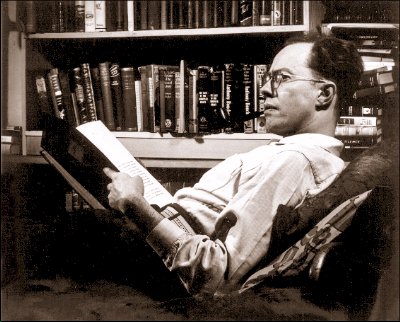
| Boucher once explained that he had chosen his widely-used pseudonym (his own second name combined with the maiden name of his maternal grandmother) when he discovered that the Library of Congress listed 75 authors by the name of William White. Boucher also wrote under the pseudonym H. H. Holmes. This pseudonym did not relate to Sherlock Holmes, as might be surmised by Boucher's status as a Sherlockian, but was the professional name of a notorious mass murderer. The killer's real name, Herman W. Mudgett, was also used as a pseudonym by Boucher. |
Boucher spoke seven languages; wrote mystery novels, as well as mystery,
fantasy, and science fiction stories; edited the Magazine of Fantasy and Science
Fiction for its first nine years; edited mystery and science fiction anthologies;
produced a weekly radio special on opera; wrote opera reviews; worked as a TV consultant;
helped found Mystery Writers of America, serving as its president in 1951; founded a west
coast branch of the Baker Street Irregulars; wrote translations; served on the California
Democratic Central Committee; became very active in the Catholic Church after Vatican II;
enthusiastically followed sporting events (football, rugby, track, and gymnastics); became
an accomplished gourmet cook; was an exceptionally talented poker player; encouraged and
advised countless mystery and science fiction authors; and was a devoted husband and father. This staggering list of accomplishments becomes even more remarkable when one considers that Boucher was a life-long asthmatic who rarely had a day of normal health. Boucher (rhymes with voucher) was born William Anthony Parker White on August 21, 1911 in Oakland, California. His parents, James Taylor White (who died when Boucher was an infant) and Mary Ellen (Parker) White, were both physicians. He was frequently bedridden as a child. Nevertheless, he easily kept up with his classmates. He was so bright, in fact, that he was included with a group of children for a Stanford university study of genius. Boucher graduated from Pasadena High School in 1928, and attended Pasadena Junior College and then the University of Southern California, where he received a B.A. in Spanish (1932) and a graduate fellowship to the University of California at Berkeley. There he met his future wife, Phyllis Mary Price, who kindly granted an interview for this article. |
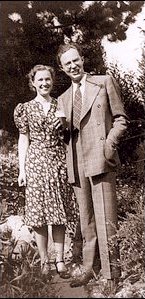 Phyllis White with her husband, Anthony Boucher. (Manuscripts Department, Lilly Library, Indiana University, Bloomington, Indiana) |
Phyllis White: "I met my husband at a student party at my parents' house. My father
was Lawrence Marsden Price of the University of California German Department, and my parents
often entertained students. I remember the first time he came to our house he addressed just
one remark to me. He asked whether I knew what became of the cookies." "After he had been to a couple of parties at my parent's house, he invited us all to dinner at an apartment he had near the campus with his mother. At the end of the dinner he made a date with me to go to the theater with him." "My first date with my future husband was the first date I ever had. I never dated in high school. One of the things we talked about was how much we liked the old theater stock companies. That was a great institution, but it had died by the time we met. There was at that time an attempt to revive it in Oakland, and we went to check it out. The theater was called 'The Fulton Theater' -- it isn't there anymore. It was a bit disappointing: it wasn't like the real old-time stock companies at all. He met me at my house and after the theater we went and had refreshments at a place nearby. The play we saw was called 'Gambling, Gambling'!" "His mother was an unusual woman because in her time there weren't so many woman doctors. And what was also pretty unusual for her time, she smoked and drank, too. She was about average height with white hair and blue eyes. She was very intelligent and very opinionated. We used to have lively discussions. She was a Republican, and we were Democrats. The fact that we were to her left made us personally responsible for everything the Communists did." "His grandfather, who died shortly before we met, meant a lot to him. He was a lawyer and a Civil War veteran. He had come to America from Scotland, where he had been an iron worker in Glasgow. I think there was an arrangement for men to get free passage if they would fight in the Civil War. I doubt he could have afforded passage otherwise." "I gathered he was something of a rake. Quite an old rogue. My husband enjoyed that in people." "He had a lot of friends of both sexes on campus. He had a gift for friendship. And he was always a great appreciator of women, and ahead of his time in giving them their due. He would be happy to see what's happened in the mystery field." |
 Arthur Ryder (1877-1938) a professor of Sanskrit at the University of California, Berkeley, provided the model for Dr. John Ashwin, a Sanskrit professor who turns to detection with the encouragement of graduate student Martin Lamb in Boucher's delightful first novel, The Case of the Seven of Calvary. Ashwin, in fact, is the Sanskrit word for "rider." Lamb is a transparent stand-in for Boucher himself. (Bancroft Library, University of California) Phyllis White: "I never met Dr. Ryder, but I used to hear a lot about him. Tony was studying with him when we met. A pleasant habit of Dr. Ryder was to invite my husband over for an evening of talk, occasionally. And, he would have on hand a bottle of scotch. At the end of the evening he would present Tony with what was left to take away with him." |
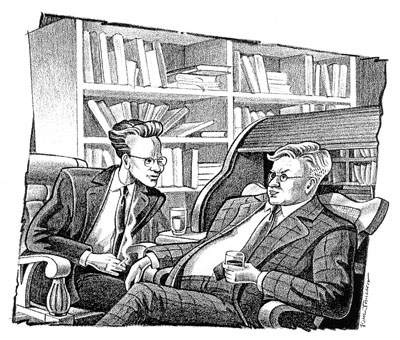 Ashwin leaned back in the swivel chair. "Now, just what is it you want me to do? Play detective with you?" (Illustration © 1993, Fiske & Elly-Ann Miles) Boucher went to Los Angeles in 1934 to become a scriptwriter but was unable to get work. He began reviewing theater and music for a small weekly paper, the United Progressive News, and tried unsuccessfully to publish short stories, poems, and translations. Finally, Lee Wright, an editor at Simon and Schuster, discovered The Case of the Seven of Calvary in her slush pile and took it up with enthusiasm. The novel was published in 1937. On the strength of this success, he proposed to Phyllis Price. The couple was married on May 19, 1938. Phyllis worked as a librarian for several years before the birth of their first son, Lawrence Taylor White. Boucher sold six more novels, but was unable to get work as a scriptwriter in Hollywood. The couple returned to Berkeley in 1942, shortly before the birth of their second son, James Marsden White. Boucher began reviewing mysteries and science fiction for the San Francisco Chronicle, published stories in Ellery Queen Mystery Magazine, edited The Pocket Book of True Crime Stories (1943) and Great American Detective Stories (1945), and collaborated on radio mystery scripts. In 1951, he became the mystery reviewer for the New York Times. |
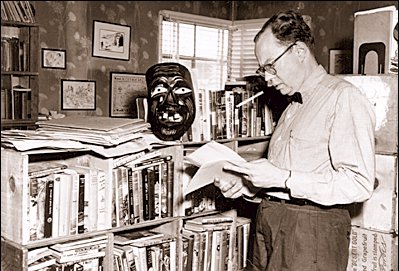
| "His study was on the top floor of our large split-level house, on the side where he got the sun in the morning. It was a large room, I guess about 12 by 20 feet, maybe even larger because it was lined with books all the way around. The windows were not covered but every part of the wall was. The main type of bookcase was an orange crate, which was nice because it is modular and you could stack books two deep. In his study he had his mystery collection, his science fiction collection, his Sherlock Holmes collection, his true crime collection, his limerick collection, and a lot of reference books." (Lawrence White, from Boucher: A Family Portrait.) (Photo Credit: Manuscripts Department, Lilly Library, Indiana University, Bloomington, Indiana) |
Lenore Glen Offord described Boucher's career as a reviewer in these words: "There is a
difference, significant but not always recognized, between reviewing and criticism ....
Anthony Boucher was a critic. He brought to his work an encyclopedic knowledge of the
mystery, in both long and short forms, and could relate the subject at hand to the genre as a
whole. Through his own experience as a writer he understood the difficulties of mystery
technique; also, he could be strict with those who didn't understand them ... above all, he
respected the craft." (The Armchair Detective, January 1969) |
|
In addition to the wonderful information provided by Mrs. White, sources for
this article include: "Criminals at Large," Anthony Boucher, New York Times Book Review. These columns provide a wealth of information for mystery fans and are readily available on micro film at many libraries. "Introduction: The World of Anthony Boucher," Francis M. Nevins, Exuent Murderers. "Anthony Boucher," Robert E. Briney, Twentieth Century Crime and Mystery Writers, 3rd edition. "A Boucher Portrait: Anthony Boucher as Seen by His Friends and Colleagues," compiled by Lenore Glen Offord, The Armchair Detective, January 1969. Boucher: A Family Portrait, Phyllis White and Lawrence White, Berkeley Historical Society, 1985. "Introduction," J. Francis McComas, Crimes and Misfortunes (Random House, 1970). |
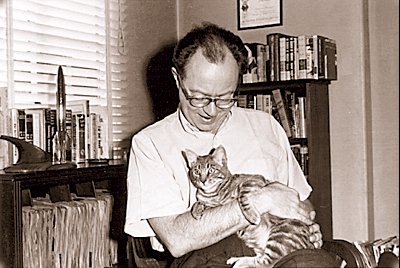 Manuscripts Department, Lilly Library, Indiana University, Bloomington, Indiana
Anthony Boucher died of lung cancer on April 29, 1968 at the Kaiser Foundation Hospital. © 1993, Fiske & Elly-Ann Miles |